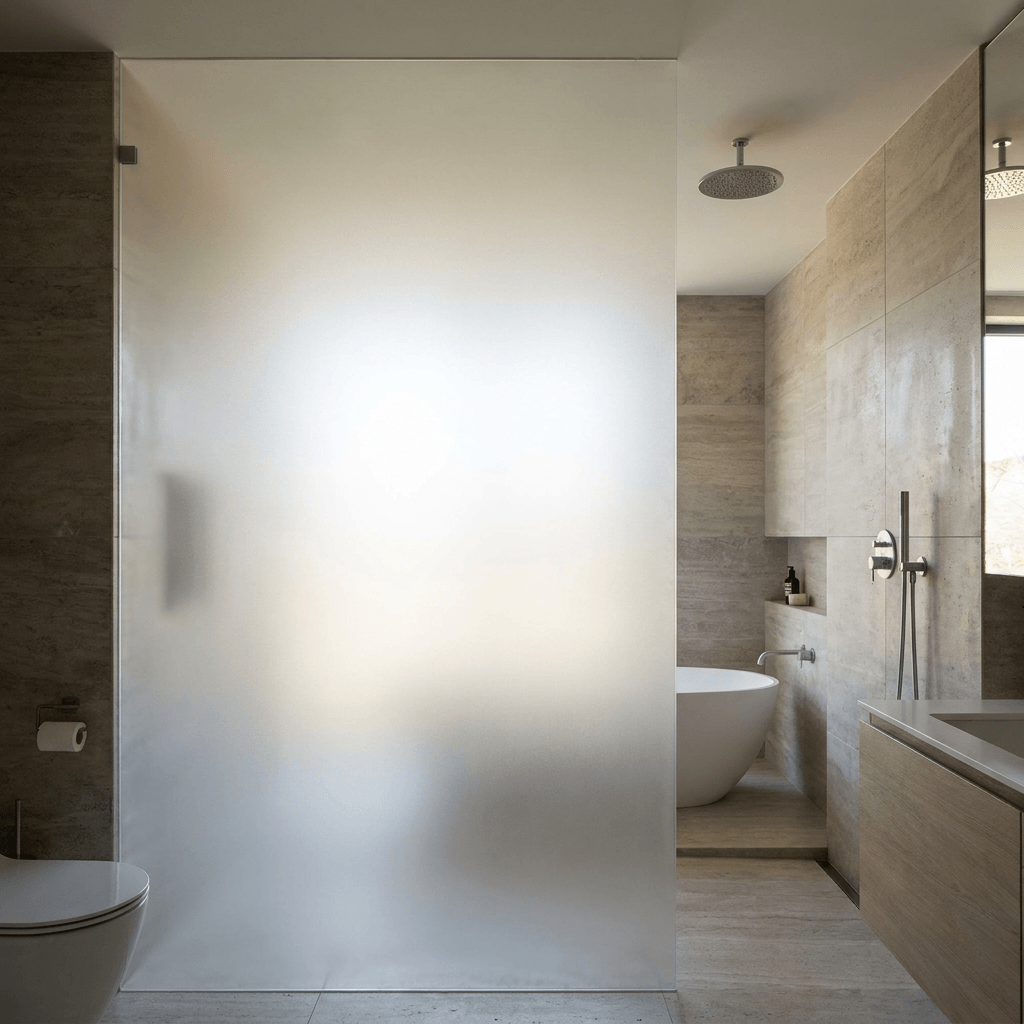
Here’s what I tell most customers first. Tempered glass is ordinary glass that we heat to roughly 620°C (about 1,150°F) and then cool fast enough to lock its surfaces into compression. The result has about four times the breakage strength of annealed (untreated) glass of the same thickness, and when it breaks, it crumbles into small pieces instead of long shards.

Most of the questions we get come back to three things. First, every cut, hole, and notch has to be finished before the glass goes into the furnace, because a tempered panel can’t be modified afterward. Second, small pieces can still fall out of the frame, so a broken panel can leave an opening unprotected. Third, polarized sunglasses and a clean edge won’t tell you what you’re holding. Permanent markings and paperwork will.
This page gives you the whole picture. Where a topic deserves more room, there’s a deeper guide you can follow.
What Is Tempered Glass?
Tempering builds a stress pattern into the glass. The surfaces end up squeezed in compression while the core stays in balancing tension, and that squeeze is where the added strength comes from.
You’ll also hear “toughened glass,” especially in European specifications. It’s the same family of product. Heat-strengthened glass is tempered glass’s close relative: the same equipment makes both, and the difference is how fast the glass cools. Order one when you need the other and you’ll get a different product, so say which you mean.

Tempered Glass at a Glance
If you’d like the answers in one place, here they are:
| Question | Short answer |
| How strong is it? | About 4× annealed glass of the same size and thickness |
| How does it break? | Into small pieces instead of long shards |
| Can you cut or drill it afterward? | No; all fabrication comes first |
| Does it count as safety glazing? | Yes, when it meets the safety standards |
| Where is it typically used? | Doors, shower enclosures, partitions, and other spots where people may hit the glass |
| Biggest watch-outs | Pieces can fall out of the frame, and spontaneous breakage is rare but possible |
How Strong Is Tempered Glass?
Strength is usually the first thing customers ask about, so let’s start there. A widely used rule of thumb says heat-strengthened glass has roughly twice the breakage strength of annealed glass of the same thickness, and fully tempered glass roughly four times.
| Glass treatment | Approximate strength | Deflection under the same load* |
| Annealed | 1× (baseline) | Baseline |
| Heat-strengthened | About 2× | Same |
| Fully tempered | About 4× | Same |
Same panel size, thickness, supports, and uniform load. These are comparisons, not design values.
Here’s the part that catches people off guard: tempering raises strength, not stiffness. The National Glass Association (NGA) points out that heat treatment leaves stiffness, hardness, and thermal conductivity unchanged. A tempered shelf sags exactly as far as an annealed one under the same load. It just takes far more load to break it.
So treat the multipliers as a way to compare treatments, not as a promise that a panel carries four times a given weight. Span, supports, load, and thickness still decide whether a panel works, so have someone check them for your project before you lock the specification.
Tempered Glass Pros and Cons
Strength is only half the picture, though. Every glass choice is a trade, so here’s what tempering buys you and what it costs.
What You Gain

Heat treatment makes glass better at resisting wind and snow loads and thermal stress, such as the stress from the sun’s radiant heat. It also improves resistance to thermal shock compared with annealed glass.
The break pattern is the other big gain. Fully tempered glass built to the safety standards breaks into relatively small pieces, which greatly reduces the risk of serious cuts and piercing injuries.
What You Give Up
Small pieces can still fall out of the frame, sometimes most of the pane at once. That’s why a safety label doesn’t settle the fallout question. The Safety Glazing Certification Council (SGCC) points out that the safety glazing standards test how glass breaks, not what happens afterward.
Heat treatment also changes how the glass looks. It can leave roll wave, a faint ripple from the roller furnace that shows up as bent reflections, and a strain pattern, a soft arrangement of light and dark spots under polarized light. Neither is a defect, but if the glass will be prominent, agree on appearance before you order.
Fully tempered glass can also break spontaneously. It’s rare, but real, and heat-strengthened glass virtually eliminates the risk. NGA suggests using heat-strengthened glass wherever possible and saving tempered for code compliance, design loads, and thermal stress. That’s why we’ll sometimes talk a customer out of tempered. It’s the right call on plenty of projects, just not automatically.
What Tempering Doesn’t Change
Color, clarity, light transmission, hardness, thermal conductivity, and stiffness all stay the same. So tempering alone doesn’t make glass scratch-resistant or better insulated. For sound reduction, look at laminated construction. For energy performance, look at the coatings and the make-up of the glazing unit.
Which Glass Does Your Project Need?
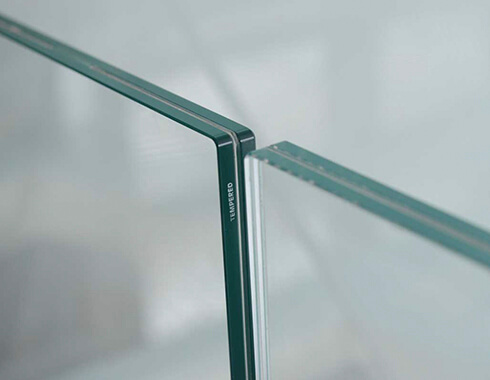
Once you know the trade-offs, the real question is which glass suits your opening. Tempered, heat-strengthened, and laminated glass answer different questions. The first two describe how glass is heat-treated. Laminated describes how layers are bonded around a plastic interlayer. They also combine, since a laminated panel can contain tempered plies.
The opening usually decides it. Building codes require safety glazing wherever people are likely to hit the glass, and the SGCC’s summary of the 2018 International Building Code (IBC) lists glazing in and beside doors, guards and railings, wet surfaces, and areas next to stairways and ramps, each with exceptions. Check which code edition applies to your site. In practice, doors, shower enclosures, and partitions typically call for certified tempered glass.
Railings work differently. The 2015 IBC requires laminated glass built from tempered or heat-strengthened plies wherever a walking surface sits below, which is why we’d steer a railing project toward laminated tempered glass instead of simply thicker monolithic glass. Overhead glazing and canopies usually need laminated glass too. A fire rating, meanwhile, comes only from a tested, labeled assembly, never from strength alone.
Strength isn’t always the goal, either. For windows above the ground floor, NGA typically recommends heat-strengthened glass for the exterior pane of an insulating unit when annealed glass can’t handle the wind or thermal stress. And if you build an insulating glass unit (two or more panes with a sealed gap) as safety glazing, every pane has to qualify.
Read the full comparison: tempered vs heat-strengthened vs laminated glass →
How Is Tempered Glass Made?
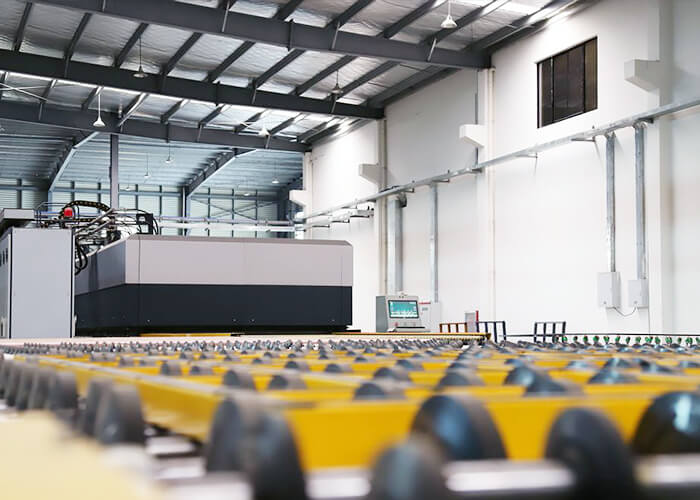
Picking the right glass is half the job. The other half is understanding how it’s made, because the process explains why tempered glass behaves the way it does. The order of work tells the whole story: finalize the drawing, cut, drill, notch, and edge, wash, heat, quench, and verify. All fabrication happens first, because a finished panel can’t take a new hole or a trimmed edge.
That’s also where the most expensive mistake happens. The one we see cost customers the most is releasing the glass drawing before the hinge or patch fitting is confirmed. Wrong cutouts, hole spacing, pivot centers, or a mirrored panel (left where you needed right) usually mean remaking the glass from scratch, and that can hold up your installation for weeks.
In the furnace, the glass rides rollers through an oven and heats to roughly 620°C, then air blows onto both surfaces at once. Cooling the surfaces first creates the compression layer, and the cooling rate decides whether you end up with tempered or heat-strengthened glass.
Edge quality matters more than people expect. A chipped edge can undo much of the benefit of tempering, and the furnace can’t repair it.
See how tempered glass is made, step by step →
What We Check Before Tempered Glass Ships
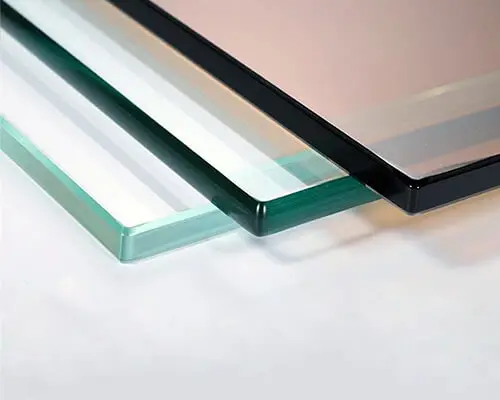
Making the panel is only part of the job, and the checking stage matters just as much. Before a panel leaves us, we check the numbers first: quantity, thickness, dimensions, and diagonals. Then we look at the fabrication: holes, cutouts, edges, and corners. Then the glass itself: scratches, chips, flatness, and tempering quality.
We also verify the safety marks and labels, and we check how the order is packed: export crates, protective materials, and loading conditions. Glass that’s perfect at our door can still arrive damaged, so packing gets the same attention as the glass.
If your supplier can’t tell you what they check, ask. It tells you a lot about what you’ll receive.
Why Does Tempered Glass Shatter on Its Own?
Even a well-made, well-checked panel can occasionally surprise you, and when it does, the first question is usually why it broke. A panel that breaks with no obvious impact has several possible causes: installation problems, temperature changes, damaged edges or surfaces, and, rarely, nickel sulfide (NiS) inclusions, which are tiny impurities that can sit inside the glass. The break itself doesn’t tell you which one it was, so a useful investigation looks at the panel, the hardware, the supports, and the installation history together.
Heat soaking, an extra heating step that makes a harmful inclusion break the panel in the oven, lowers the risk. As NGA stresses, though, it reduces the risk but doesn’t eliminate it. If your project needs it, ask whether every panel gets soaked, and plan extra time in the schedule.
If a panel does break, keep people clear, contact the installer, and hold on to the label and order records.
Read the full guide to spontaneous breakage and heat soaking →
How Can You Tell If Glass Is Tempered?

If you’re ever left wondering what you actually have, there’s a sensible order to check things in. Start with the mark and the paperwork. Look for a permanent stamp or etch in a corner, which usually names the safety standard the glass was tested to, and ask your supplier for matching certification records.
Polarized sunglasses can sometimes reveal a strain pattern, but it appears in tempered and heat-strengthened glass alike and depends on lighting and viewing angle. A pattern tells you the glass is heat-treated, and no pattern doesn’t prove it’s annealed. Edge finish is a choice written into the order, so it says nothing about the treatment either.
A break can teach you something too, since small pieces suggest tempering, but that clue arrives too late to help with identification. Please don’t drill, score, strike, or heat a panel to find out. If identity matters for cutting, reuse, or safety glazing, get documents or professional testing.
Read the full guide to identifying tempered glass →
Which Certificate Will Your Market Ask For?
Marks and paperwork lead to the next question: what will your market expect to see? Most markets want a safety-glazing mark. In the U.S., that means tempered glass tested to ANSI Z97.1 or the federal 16 CFR 1201, usually shown by a third-party certification label. In Europe, it’s EN 12150-1, the standard for thermally toughened safety glass. Other markets have their own, so tell us where the glass is going and we’ll confirm which marks and documents to expect.
A standard named on a quote tells you the target, not the proof. Ask for records that match the product, thickness, and factory you’re buying from.
See the full guide to tempered glass standards and certifications →
What Should You Send Before You Order?
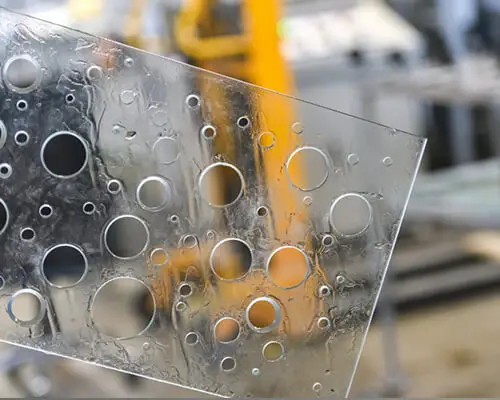
Once you know what paperwork to expect, the last step is getting your order details right, which is where most delays start. The most common gap we see is a customer who sends only the glass size. What’s missing is the final hardware model, hole positions, edge finish, opening direction, tolerances, and certification requirements. Every one of those has to be confirmed before tempering, because the glass can’t be modified afterward.
So send the full picture: the application and destination, the glass construction (single sheet, laminated, or insulating unit), thickness, one approved drawing revision, the hardware model with hole and notch positions, edge finish, opening direction, tolerances, certification requirements, any extra processing such as heat soaking, and quantity and delivery.
Size and thickness matter too. Architectural tempered glass typically runs from 3 mm to 19 mm, and jumbo panels can reach about 3300 × 12000 mm, depending on thickness, glass type, coating, and processing. Send us your size and we’ll tell you what’s possible.
Settle what the price includes as well: glass only or installed, packing included or separate, and which delivery terms apply. Size, thickness, processing, quantity, and logistics all move the price, which is why our custom tempered glass page asks for those details with every quotation request. Agree how you’ll check dimensions, markings, damage, and appearance when the glass arrives, and two quotes with different boundaries will stop looking the same.
Get the full tempered glass order checklist →
Cleaning and Replacing Tempered Glass

Once your glass has arrived and been installed, a little care keeps it looking its best. Clean tempered glass like any other glass, and skip scrapers, abrasives, and harsh chemicals, which can cause permanent damage. Heat-treated surfaces can carry tiny particles you can feel but not see, and scraping them off is how many panels get scratched.
If a panel is visibly damaged or breaks, keep people away from the area and contact the installer. Keep the label and your order records, since the label can help identify the fabricator and make replacement faster.
Questions Customers Ask Us
A few questions come up again and again, so here are quick answers.
Is Thicker Tempered Glass Always Safer?
It’s a fair thing to wonder, and the answer is: not necessarily. The right thickness also depends on the application, panel size, support method, design load, hardware, and local building codes. For railings, laminated tempered glass may be more appropriate than simply using thicker monolithic glass. Thickness is one input, not the whole answer.
Is Tempered Glass Unbreakable?
Short answer: no. It’s stronger than comparable annealed glass, but damage, installation problems, temperature changes, and inclusions can still break it. The safety standards address how glass breaks, not whether it does.
Can Tempered Glass Be Cut or Drilled?
Unfortunately, no. All fabrication has to be finished before heat treatment, so we’d make you a new, correctly fabricated panel when dimensions or holes change. That’s why we push so hard to confirm details up front.
Is All Tempered Glass Safety Glass?
Not always. Fully tempered glass counts as safety glazing only when it meets the safety standards, and heat-strengthened glass doesn’t count unless it’s laminated. Look for the certification mark instead of relying on the word “tempered.”
Why Does Tempered Glass Sometimes Look Wavy?
Because the glass rides rollers through a hot furnace, it can pick up roll wave, a faint ripple you notice most in reflections. It’s a known characteristic of heat treatment, so agree on appearance expectations before production and ask whether your supplier checks flatness.
Is a Tempered Glass Phone Protector the Same Thing?
Not quite. Some phone cover glass uses chemical strengthening, a different process, so the architectural points above don’t carry over. Check the maker’s product information.
Send Us Your Drawing, and We’ll Tell You What We’d Check First
If one of these answers doesn’t quite fit your project, that’s a good reason to talk to us. If you’re planning a tempered glass order, send us the application, destination market, drawings or approved dimensions, glass construction, hardware model, hole and edge details, quantity, and any certification you need. We’ll go through it with you and flag anything that needs confirming before tempering starts.
Not sure what to include? Start with our custom tempered glass capabilities, and ask us anything that’s unclear.