No. Low-e glass blocks most UV as a side effect of its heat-reflective coating — typically 75% to 95%, depending on coating type — but not all of it. For near-total UV blocking, laminated glass is required.
A distributor’s client sees faded flooring or merchandise after a season of sun and assumes the low-e glass they ordered should have prevented it. It wasn’t spec’d wrong — “energy-efficient” and “UV-blocking” just aren’t the same thing.
We cover the full mechanics of low-e coatings in the ultimate guide to low-e glass. This piece stays narrow, on the UV question specifically.
Heat Is the Job, UV Is the Side Effect
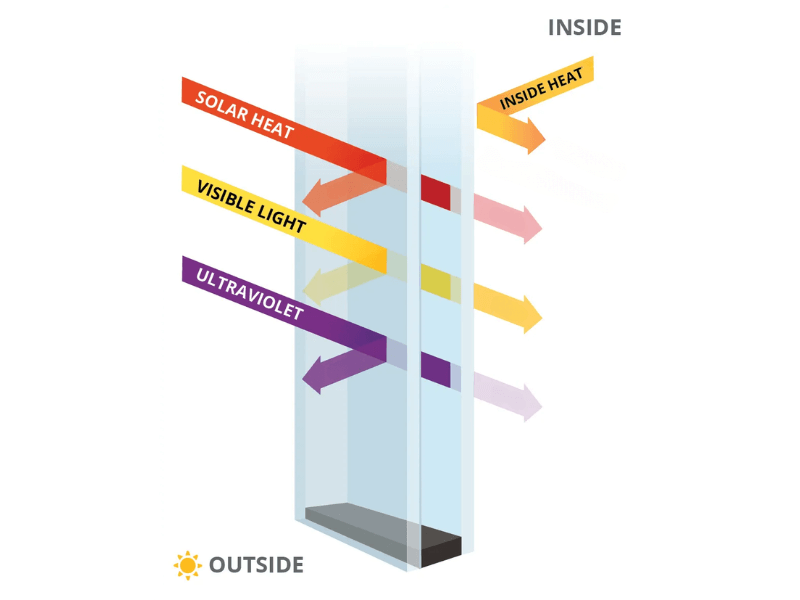
Low-e coatings target infrared heat, not UV. The coating reflects long-wave infrared radiation (roughly 700–2500 nm) back out of the glass — that’s the entire basis of its heat-management performance.
Why It Also Blocks Some UV
UV sits at the opposite end of the spectrum (100–400 nm). The same metallic coating that reflects infrared happens to reflect a meaningful portion of UV along with it — but it’s tuned for the infrared job first.
UVA vs. UVB: Why the Split Matters
Not all UV behaves the same way, and that’s part of why a single “UV blocked” number can be misleading.
UVB is the shorter-wavelength band responsible for sunburn, and glass — coated or not — already blocks most of it; that’s well established in dermatology guidance, which is why you can’t get a sunburn sitting behind an ordinary window.
UVA is the longer-wavelength band tied to long-term skin aging and DNA damage, and it passes through glass far more easily. So a low-e coating’s UV transmittance number is mostly a story about how much UVA is still getting through — the UVB fraction was already low before the coating did anything.
For hospitals, schools, and other spaces with long daily occupancy near glazing, that UVA fraction is the number worth asking about specifically, not the blended UV total.

The Metric Most Spec Sheets Skip
Here’s where a lot of confusion starts: the standard NFRC window label reports U-factor, solar heat gain coefficient (SHGC), and visible transmittance (VT) — these three are the mandatory fields. UV transmittance isn’t one of them. A buyer can read a perfectly good NFRC label front to back and never see a UV number, because it isn’t required to be there.
If UV performance matters to a project, it has to be requested separately — it won’t show up by default on the same document that lists everything else.
How Much UV Does Low-E Actually Block?
DOE’s consumer window guide puts fading reduction from a low-e coating at up to 75% versus uncoated glass. Higher-performance soft coat, multi-silver configurations push UV transmittance lower still, often into the single digits.
By Coating Type
| Coating Type | Typical UV Transmittance | When to Spec It |
| Hard coat (pyrolytic) low-e | ~15–25% | Standard residential, budget-driven projects |
| Soft coat, single silver low-e | ~8–15% | Most commercial and residential glazing |
| Soft coat, double/triple silver low-e | ~3–8% | High-performance thermal + fading-sensitive interiors |
| Low-e + laminated (PVB/SGP ply) | <1% | Museums, archives, high-value display glazing |
Two Things That Drive the Range
Coating type accounts for most of the spread. Soft coat (sputtered) low-e generally blocks more UV than hard coat (pyrolytic), since the sputtered silver layers are denser and the effect multiplies across additional layers in double- or triple-silver stacks.
Coating position in the IGU (insulated glass unit — the sealed multi-pane assembly behind a finished window) matters too: a coating closer to the outdoor side intercepts more UV before it reaches the interior.
How to Verify a Supplier’s UV Number
A UV percentage on a data sheet is only as good as the test behind it. Two things separate a real number from a marketing claim.
What a Real Test Report Looks Like
A legitimate UV transmittance figure is tested to EN 410 or ISO 9050 and reported for the exact finished configuration — the specific coating, on its specific surface, in the specific IGU build being ordered. A number for “our low-e coating” in general, without a configuration attached, isn’t the same thing.
Coating position and pane thickness both shift the result, so the same coating can report differently depending on where it sits in the stack.
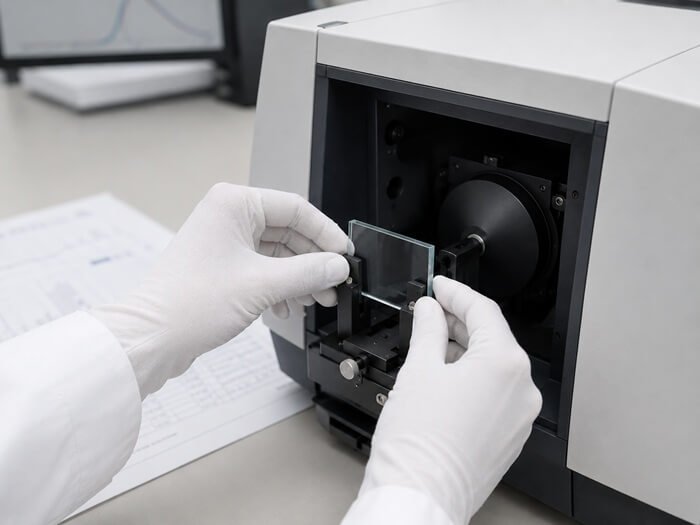
A proper report also names the testing lab, gives a test date, and lists the exact glass makeup it was run on — pane thicknesses, coating type and surface, gas fill, spacer type. If a supplier hands over a one-line UV figure with no lab name and no build description attached, ask where it came from before you spec around it.
Red Flags in a Spec Sheet
Watch for a UV figure with no test standard cited, a range instead of a tested value (“blocks up to 95% of UV” with no lower bound), or a number that’s identical across every product line the supplier sells — that usually means it’s a marketing figure copied across the catalog rather than a result from an actual lab report for that build.
When Low-E Alone Isn’t Enough
Three project types consistently need more UV blocking than standard low-e delivers. Museum, gallery, and archival projects deal with textiles, paper, and photographic materials that fade under long-term UV exposure even at low transmittance levels — conservation-grade specs typically call for UV transmittance below 1%.
High-value retail and display glazing faces the same problem on a shorter timeline: apparel, printed materials, and some cosmetics fade under sustained direct sun just like museum pieces do.
The third is occupant-exposure spaces — hospitals, schools, offices, and sunrooms where people spend hours a day near glazing. Here the concern isn’t fading, it’s the cumulative UVA exposure discussed above. A standard low-e spec that’s perfectly adequate for protecting a floor won’t necessarily satisfy a client asking specifically about long-term skin exposure in a sun-facing patient room or classroom.
The Fix: Laminated Glass
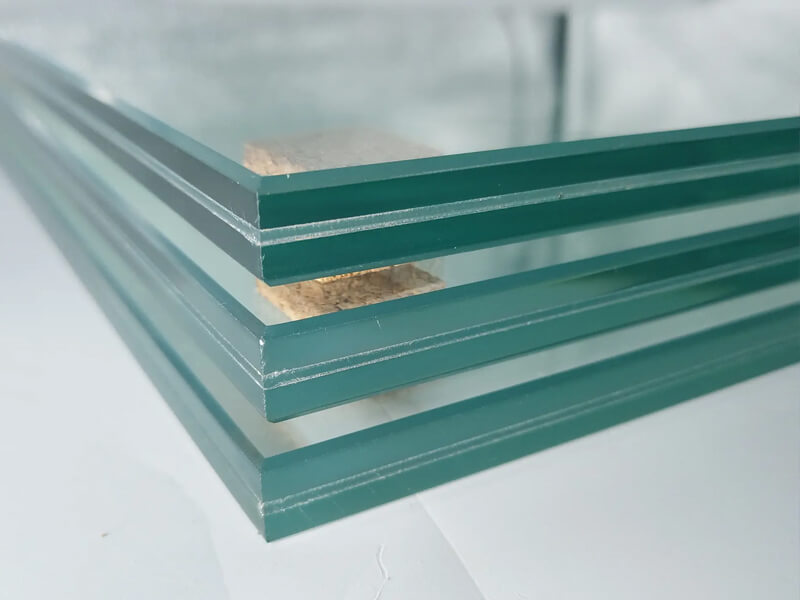
A PVB or SGP interlayer bonded between two glass plies absorbs almost all UV radiation — industry technical data puts laminated glass UV blocking above 99%, the same principle used in automotive windshields. Combining the two — low-e on one surface, a laminated ply elsewhere in the same IGU — is the standard high-performance spec: the coating manages heat, the laminate handles the residual UV.
What the Upgrade Actually Costs
Laminated glass carries a real cost premium over standard low-e IGU construction — the interlayer bonding process is a separate manufacturing step, and the premium scales with glass thickness and interlayer type. Exact figures vary by fabricator, order volume, and region, so treat any flat percentage you’re quoted online as a starting point for a conversation, not a number to plan a budget around.
For a project where UV blocking is optional rather than required, that premium is the deciding factor; for museum, archival, or high-value display work, it’s a cost of meeting the spec, not an upsell.

What to Ask Your Glass Supplier
- What is the UV transmittance (τ_UV or T_uv) of this exact IGU configuration, tested to EN 410 or ISO 9050 — not a general range for the coating family?
- Is the coating hard coat or soft coat, and on which surface of the IGU?
- If the project needs 99%+ UV blocking, can the order include a laminated ply, and what’s its documented UV transmittance?
- Is there a lab test report backing the number, or only a marketing data sheet?
If a supplier can’t answer these cleanly, that’s usually a sign the product is commodity-grade, or that the person you’re talking to doesn’t actually know their own glass.
That’s the conversation worth having before the order goes in — not after a client calls about a faded floor. The distributor from the start of this piece didn’t spec the wrong glass; they just never got a UV number attached to the order in the first place. Asking for it costs nothing and settles the question before it becomes a complaint.