At a Glance: Why This Matters to Your P&L
- The Root Cause: Most shower glass failures (sagging, slipping, spontaneous breakage) originate from “rough” cutouts and loose tolerances, not installation errors.
- The Solution: Switching to CNC-machined “Mouse Ear” cutouts mechanically locks hinges in place, removing the reliance on friction gaskets.
- The ROI: Specifying proper fillet radii and polished edges costs pennies upfront but eliminates hours of expensive site adjustments and warranty callbacks.
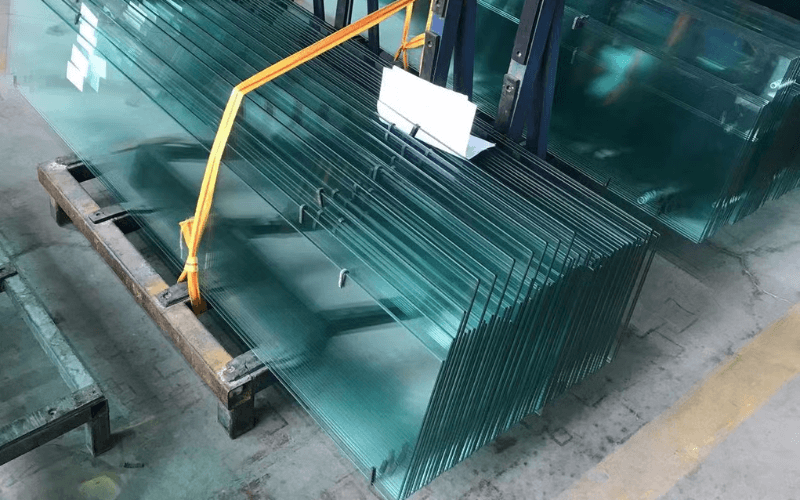
Introduction: The Gap Between the Drawing and the Door
In the commercial and high-end residential glass market, there is a pervasive myth: “Glass is a commodity. If the dimensions are right, the glass is right.”
As a sourcing manager or project leader, you know this isn’t true. You know that two pieces of 12mm tempered glass can look identical on a shop drawing, yet behave completely differently once they are hung on a hinge. One door installs in 20 minutes and swings perfectly for a decade. The other fights the installer for an hour, requires three return service trips to adjust the sag, and eventually shatters “spontaneously” eighteen months later.
The difference isn’t usually the float glass substrate itself. It isn’t even the tempering furnace. The difference is the cutout.
The geometry, edge quality, and positional tolerance of the hardware cutouts are the single biggest predictors of a shower door’s longevity. Yet, this is the area most frequently overlooked in purchase orders (POs) and specification sheets.
At Hexad Industries, we believe that the relationship between a fabricator and a project manager should be a partnership, not a transaction. We don’t just want to sell you crates of glass; we want to help you engineer the risk out of your installation process.
This guide is your technical roadmap. We will dismantle the physics of why shower doors fail, analyze the “Mouse Ear” cutout solution, compare manufacturing methods, and give you the exact language you need to secure better glass for your next project.
The Physics of Failure
Why “Good Enough” Fabrication Destroys Profit Margins
To understand why precision matters, we have to look at how a frameless shower door actually works. In a framed system, the metal supports the glass. In a frameless system, the glass is the structure.
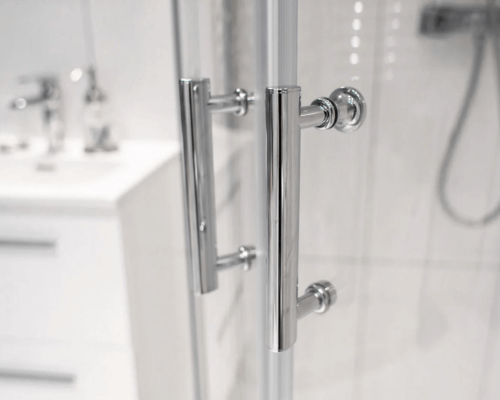
Every time a user opens a heavy, 10mm or 12mm shower door, they are applying torque to a lever arm. That torque is transferred entirely through two or three small metal hinges clamped onto the glass.
The Stress Riser Effect
Tempered glass is incredibly strong in compression (surface strength) but highly vulnerable to tension and point loading. A cutout—whether it’s a hole for a handle or a notch for a hinge—is a disruption in the surface tension of the glass. In engineering terms, this is a “Stress Riser.”
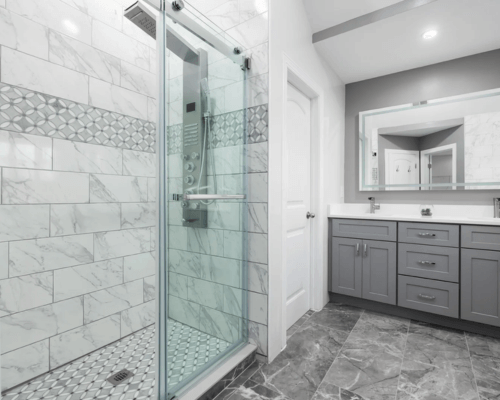
When a hinge is clamped onto a notch with rough edges, sharp corners, or poor tolerances, the mechanical load doesn’t flow smoothly through the glass. Instead, it concentrates at the imperfections.
- Micro-cracks: If the edge of the notch was ground by hand or cut with a waterjet and not polished, the surface is covered in microscopic peaks and valleys.
- The Wedge Effect: As the hinge flexes, it drives these micro-cracks deeper into the tension zone of the glass.
- Delayed Failure: This is why a door often explodes at 3:00 AM when no one is touching it. The damage was done during fabrication or installation, but the crack took months to propagate to the critical limit.
The Economic Impact on Your Project
For a project manager, these physical failures translate directly into economic losses.
- Installation Drag: If a hinge cutout is 2mm too low, the installer has to shim the door, adjust the cams to their limit, or grind the sweep to stop it from dragging. A 30-minute install turns into a 90-minute struggle. Across a 200-unit hotel project, that is hundreds of hours of lost labor.
- The “Sag” Callback: This is the most common complaint. A door is installed perfectly level. Three months later, the homeowner complains the door is rubbing the curb. Why? Because the hinge shifted in the notch.
- Reputation Risk: A shattered door in a luxury hotel or a high-end residence is a liability nightmare.
The Solution – The “Mouse Ear” Cutout
If you take only one technical recommendation from this guide, let it be this: Adopt the “Mouse Ear” cutout standard.
While standard rectangular notches are “acceptable” by basic industry standards, they are functionally inferior for heavy, frameless glass. The “Mouse Ear” is the professional standard we advocate for at Hexad.
What is a Mouse Ear Cutout?
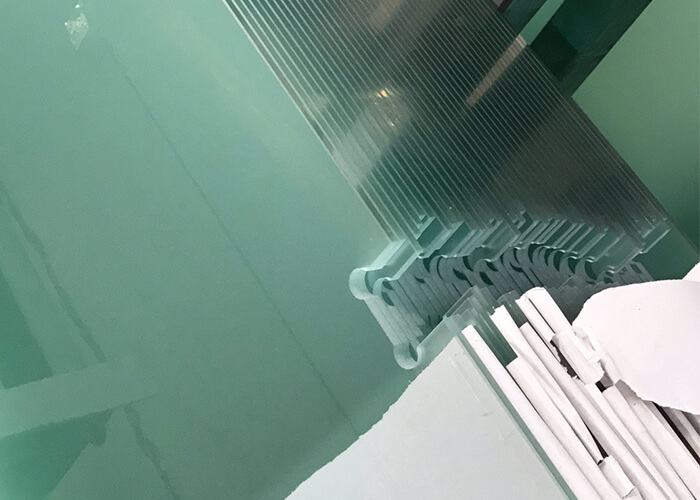
Imagine a standard rectangular notch where the hinge plate sits. Now, imagine drilling two circular holes at the inboard corners of that rectangle. The resulting shape looks like the silhouette of a mouse’s head.
This isn’t an aesthetic choice—it is a functional one.
Advantage 1: Geometric Locking (The Socket Effect)
In a standard rectangular notch, the hinge relies almost entirely on the friction of the gaskets to stay in place. The glass edge is flat; the hinge backplate is flat. Gravity pulls the door down, and only the tightness of the screws stops it from sliding.
In a “Mouse Ear” cutout, the hinge body (which often has rounded shoulders) sits inside the radiused corners of the glass. The glass actually wraps around the hinge body.
- The Result: The door is mechanically keyed into position. Gravity is resisted by the glass geometry, not just friction.
- The Benefit: We see a massive reduction in “sagging door” callbacks when partners switch to mouse ears.
Advantage 2: Stress Distribution

Glass hates sharp corners. A 90-degree internal corner is a prime location for stress to build up. By adding the “ears,” we are essentially adding a large fillet radius to the corner.
- The Physics: A larger radius distributes the stress over a wider area, rather than focusing it on a single point. This significantly raises the safety factor of the door.
Manufacturing Methodologies Explained
A CAD drawing is only as good as the machine that cuts it. When you are vetting a fabrication partner (like us, or anyone else), you need to understand how they are cutting your glass.
There are three primary methods used in the industry today. Understanding the difference is key to writing a tight specification.
Method 1: Manual Processing (Drill & Grind)
This is the traditional method. An operator uses a drill press to bore holes and a belt sander or angle grinder to cut the notches.
- The Pros: Low capital cost for the factory; fast for one-off repairs.
- The Cons: It is highly dependent on human skill.
- Drill Walk: The drill bit can wander 1–2mm before biting, leading to misalignment.
- Inconsistent Radii: One corner might be sharp; the other might be rounded.
- Heat Checks: Aggressive grinding creates localized heat, which causes micro-fractures before the glass even hits the tempering oven.
- Our Verdict: Avoid manual processing for volume frameless shower projects. The risk of variation is too high.
Method 2: Waterjet Cutting

A high-pressure stream of water mixed with garnet abrasive cuts the glass.
- The Pros: Incredible flexibility. Can cut any shape, no matter how complex. No heat generation.
- The Cons: The Edge Quality.
- A waterjet cut leaves a “frosted” or matte finish. Under a microscope, this edge is rough, consisting of thousands of tiny impact craters from the abrasive.
- Unless the fabricator performs a secondary polishing step (which takes time and money), this rough edge is weaker than a polished edge.
- Our Verdict: Excellent for complex custom shapes, but must be specified with “secondary polishing” for hinge notches.
Method 3: CNC Machining (The Hexad Standard)
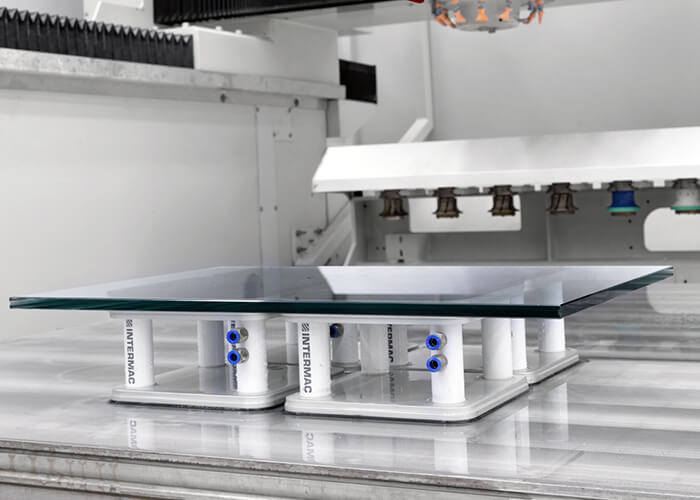
This involves a large, computer-controlled work center. The glass is held down by suction cups. A diamond-tipped milling tool cuts the notch, and then a polishing wheel passes over the same path to smooth the edge.
- The Pros:
- Precision: Tolerances of ±1.0mm or better are standard.
- Polished Internals: The CNC machine polishes the inside of the notch as part of the cycle. This removes the micro-cracks and leaves a smooth, glossy edge that is highly resistant to impact.
- Repeatability: The 1st door and the 1,000th door are identical.
- Our Verdict: This is the only process we recommend for B2B partners managing volume projects. It provides the predictability your installers need.
The “Installation Reality” Check
Why do we spend so much time talking about millimeter tolerances? Because we know what happens on the job site when we get it wrong.
Let’s walk through a scenario we see too often when project managers buy on price alone, without checking the fabrication method.
The “Friday Afternoon” Nightmare
Your installation team arrives at a hotel renovation site at 2:00 PM on a Friday. They have 10 doors to hang.
Door #1 (The “Budget” Glass):
The fabricator used manual drilling. The top hinge notch is cut 3mm too deep, and the bottom notch is 2mm too shallow.
- The Fight: The installer hangs the door. It leans. The magnetic seal touches at the bottom but has a 5mm gap at the top.
- The Fix: The installer has to take the door down. They add plastic shims inside the top hinge to push the door out. They over-tighten the bottom hinge to compress the gasket.
- The Consequence: The door looks okay, but the hinge is now clamping on an angle. The gasket is crushed. In 3 months, that gasket will permanently deform, the door will slip, and the hotel maintenance manager will be calling you.

Door #2 (The “Hexad CNC” Glass):
The glass was CNC machined using the hardware manufacturer’s DXF file.
- The Flow: The installer attaches the hinges. They lift the door. The “Mouse Ears” lock onto the hinge bodies.
- The Consequence: The door hangs plumb immediately. The reveals are perfect. The installer tightens the screws and moves to the next room.
The Math:
If “Door #1” takes an extra 45 minutes to finesse, and you have 200 doors, you have just lost 150 hours of labor. That cost dwarfs the pennies you might have saved on the glass unit price.
Partnership Note: When we discuss specs with you, our goal is to save you those 150 hours.
Developing Your Specification (The “Copy-Paste” Guide)
As a B2B buyer, your most powerful tool is your specification sheet (or your PO comments). This is where you lock in quality and prevent vendors from cutting corners.
Below are the exact technical requirements we recommend adding to your standard agreements.
1. Geometric Tolerances
Standard ASTM C1048 (Heat Treated Flat Glass) allows for fairly loose tolerances. You need to tighten them for showers.
Spec Language: “Overall dimensional tolerance ±1.5mm. Hardware cutout and hole location tolerance ±1.0mm from datum. Hole diameter tolerance ±0.5mm.”
2. Edge Work & Finish
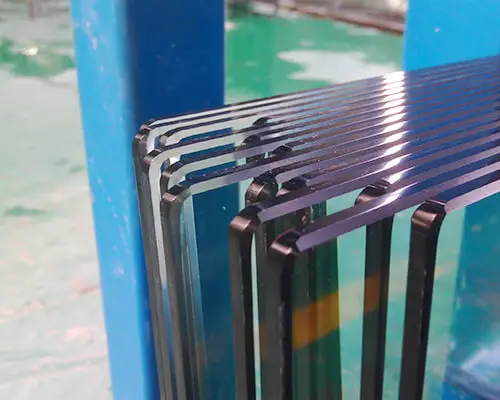
Never leave room for interpretation regarding the finish inside the notch.
Spec Language: “All hinge notches, handle holes, and hardware cutouts must be CNC machined. Internal edges of cutouts must be flat polished to remove micro-fractures. Seamed or ground edges in hinge notches are not permitted.”
3. The “Mouse Ear” Requirement
If your hardware supports it (and most standard hinges do), mandate the shape.
Spec Language: “Hinge notches to be ‘Mouse Ear’ style with internal stress-relieving radii (min 8mm) to match hardware geometry. Fabricator to verify compatibility with hardware DXF prior to production.”
4. Safety & Certification
Ensure your fabricator can prove their glass behaves safely under impact.
Spec Language: “All tempered glass must be manufactured in an ISO 9001 certified facility and meet CE EN 12150 standards for fragmentation and impact resistance. Supplier to provide batch test reports upon request.”
Global Compliance & Safety Standards
When you import glass, you aren’t just buying a material; you are buying a safety guarantee. While local codes vary, the physics of safety glass remains the same globally. You need to know that if a door breaks, it will fail safely.
At Hexad, we manufacture to rigorous International Standards to ensure our glass meets the safety requirements of global markets.
1. CE Marking (EN 12150)

This is the European gold standard for “Thermally Toughened Soda Lime Silicate Safety Glass.”
- What it tests: Much like American standards, EN 12150 mandates rigorous fragmentation tests. The glass is broken in a controlled setting, and the particles are counted.
- The Safety Standard: To pass, the glass must shatter into small, blunt “dice” rather than dangerous long shards.
- Your Assurance: When you see our CE compliance, you know the glass has been engineered and tested to minimize injury risk in the event of breakage.
2. ISO 9001 (Quality Management)
While CE tests the product, ISO 9001 tests the process.
- The Consistency Problem: Anyone can make one good piece of glass. The challenge is making 10,000 pieces that are identical.
- The Solution: Our ISO 9001 certification means we have a documented, audited Quality Management System (QMS). Every batch of glass is tracked. Every furnace setting is logged.
- Why it matters to you: It provides traceability. If you ever have an issue on site, we can trace that specific crate back to the exact production shift and furnace recipe to identify the root cause immediately.
Vetting Your Partners (The 5-Question Interview)
When you are looking for a fabrication partner, you need to determine if they are a “cutter” or an “engineer.”
Here are five questions to ask in your next vendor meeting, and the answers you should look for.
Q1: “Can your engineering team review our hardware compatibility?”
- The Wrong Answer: “Just send us the sizes, we’ll cut whatever you want.”
- The Partner Answer: “Yes. Please send us the CAD files for your hinges. We will overlay them on the glass drawings to ensure the mouse ears fit perfectly and the clearances are correct.”
Q2: “What is your standard process for hinge notches?”
- The Wrong Answer: “We hand-notch them.” (Run away).
- The Partner Answer: “We run them on a CNC vertical work center to ensure the internal edges are polished.”
Q3: “How do you handle hole-to-edge spacing?”
- The Wrong Answer: “We can put the hole wherever you want.”
- The Partner Answer: “We follow the 2x thickness rule. If you need a hole closer than 2x the glass thickness to the edge, we will flag it for review because it increases breakage risk.”
Q4: “Do you have an automated wash cycle before tempering?”
- Why this matters: Debris on the glass before tempering gets baked in, creating surface defects that ruin the look of a high-end shower.
- The Partner Answer: “Yes, all glass goes through a high-pressure horizontal washer immediately before entering the furnace.”
Q5: “How do you verify product consistency and safety?”
- The Wrong Answer: “We just look at it before it ships.”
- The Partner Answer: “We are ISO 9001 certified for process control, and our glass is tested to CE EN 12150 standards. We perform regular fragmentation tests in our lab to ensure the furnace quench is dialed in correctly.”
FAQ & Troubleshooting
Q: My installer says the ‘Mouse Ears’ are visible after the hinge is on. Is that a defect?
A: It depends on the hinge backplate size. Standard mouse ears are designed to be covered by standard 2-inch hinge plates. However, if you are using “mini” hinges, the ears might peek out.
- The Solution: This is why we ask for the hardware model upfront. We can adjust the radius of the mouse ear to hide behind smaller hinges while still providing stress relief.
Q: Can we drill a hole after the glass is tempered?
A: Absolutely not. Tempered glass is under massive internal tension (often 10,000+ psi). Breaking the surface tension with a drill bit will cause the entire panel to explode instantly. All fabrication must happen before the furnace.
Q: What is the minimum distance between two holes (e.g., for a towel bar)?
A: A safe rule of thumb is 2x the glass thickness. If you have 10mm glass, the bridge of glass between the two holes should be at least 20mm. Any less, and the glass is prone to cracking during the tempering quench.
Q: Why do flush pulls cost more than holes?
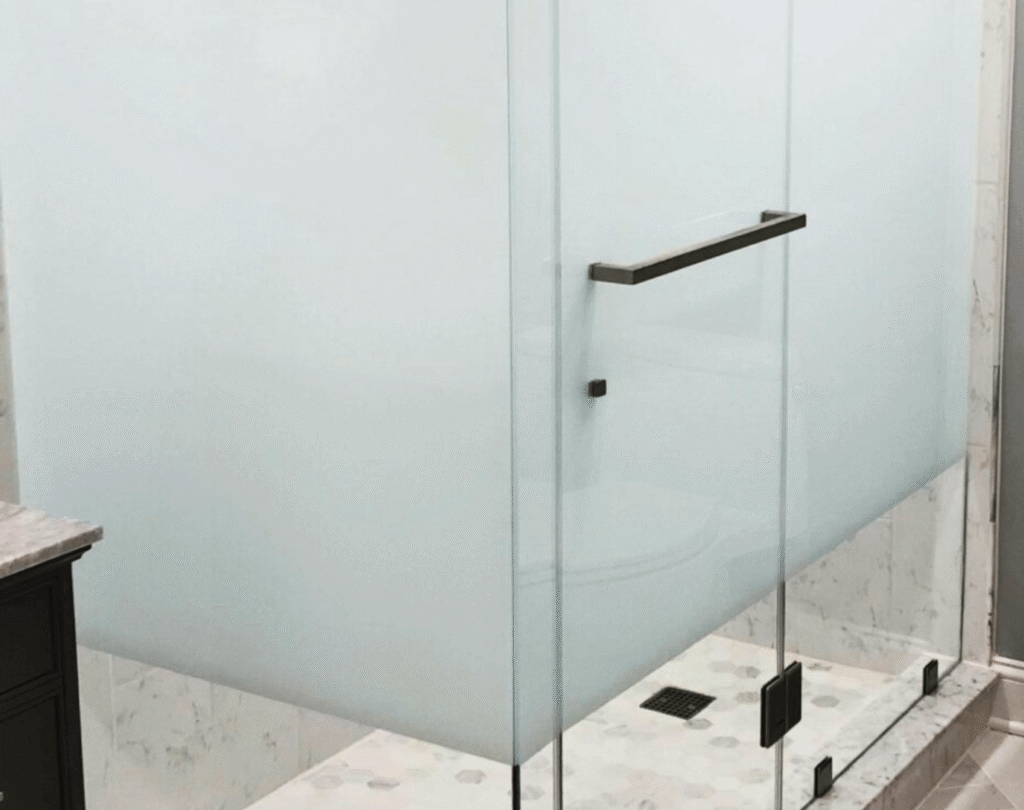
A: A hole is a simple drill operation. A flush pull requires “countersinking” or milling a pocket into the glass surface. This is a time-consuming CNC operation that requires careful depth control so the glass doesn’t become too thin at the bottom of the pocket.
Q: My project requires specific safety documentation. What can you provide?
A: We provide full CE Declaration of Performance (DoP) documents and ISO 9001 certificates. For specific projects, we can also share internal lab reports showing fragmentation counts (particle size analysis) to demonstrate that the safety performance meets or exceeds your local requirements.
Conclusion: Let’s Build Predictability
At the end of the day, your goal isn’t just to buy glass; it is to deliver a flawless project that enhances your reputation.

When you choose to prioritize CNC precision, Mouse Ear geometry, and collaborative engineering, you are making a strategic investment. You are paying a few cents more upfront to save hundreds of dollars in labor, warranty claims, and stress down the road.
We want to be the partner that helps you make that decision.
At Hexad Industries, we don’t just run machines; we solve problems. We invite you to treat our engineering team as an extension of your own.
Next Steps:
- Audit Your Drawings: Pull the shop drawings for your next project. Are the notches rectangular or Mouse Ears? Are the tolerances defined?
- Send Us a Test: Send us a set of your drawings. We will perform a free technical review, highlighting any potential stress points or fitment issues before you even place an order.